Why those 5 inches are the most important investment you’ll make this year.
Choosing between a Full (Double) and a Queen bed is the ultimate “grown-up” dilemma. Most big-box retailers will give you the technical specs, but they won’t tell you how a 6’4” man feels sleeping in a Full, why the “Waffle House” effect ruins sleep for couples, or why finding high-quality linen for a Full is becoming a chore.
We analyzed hundreds of real-world experiences from interior designers and sleepers to answer every burning question about making the jump to a Queen.
1. The Dimensional Reality: Is 5 Inches Really a “Huge” Difference?
Is it worth getting a queen size over a full bed?
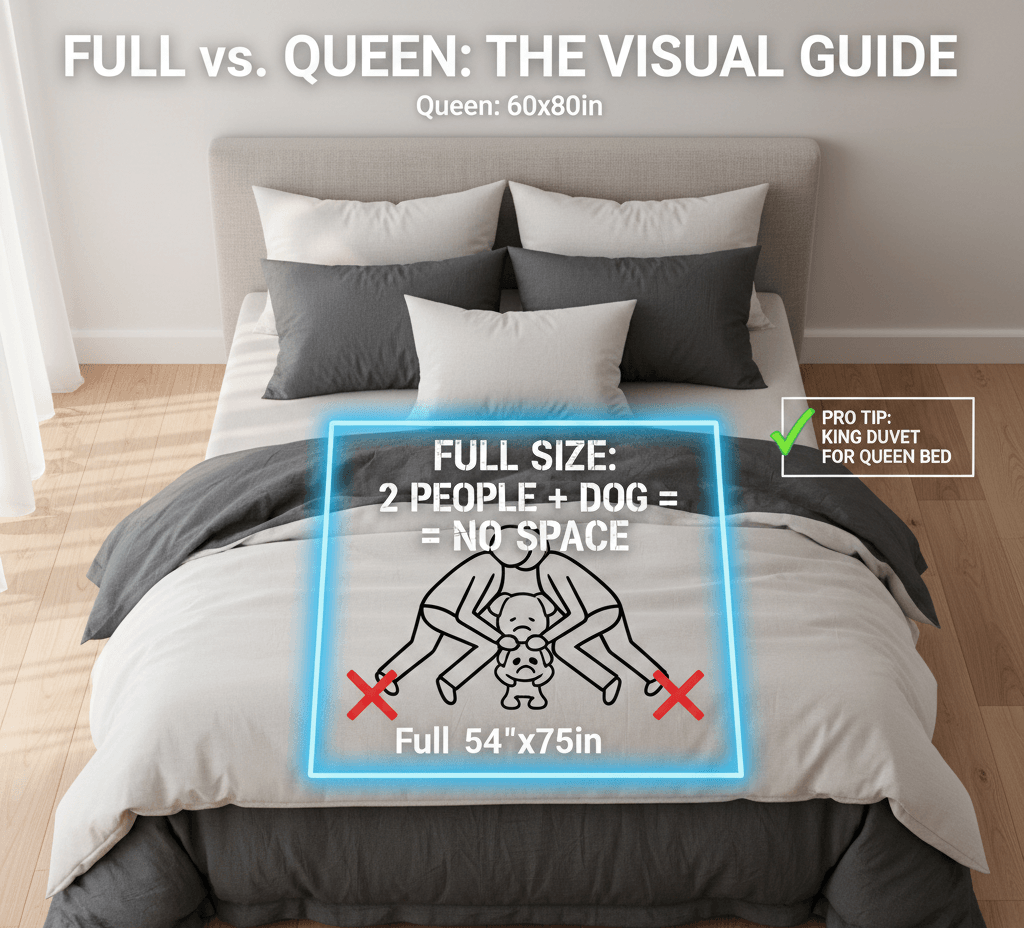
Yes, absolutely. While a Full is $54″ \times 75″$ and a Queen is $60″ \times 80″$, the difference isn’t just a measurement—it’s a lifestyle shift.
- The “Personal Bubble” Metric: In a Full bed, two people share 54 inches. That is only 27 inches per person. For context, a standard crib mattress is 28 inches wide. In a Full bed, you have less room than a literal baby.
- The Starfish Factor: For solo sleepers, the Queen allows you to “starfish” (arms and legs spread) without your limbs hitting the edge. This leads to deeper REM sleep because your brain isn’t subconsciously monitoring the “cliff” at the edge of the bed.
I’m 6’4″—can I sleep in a Full bed?
No. This is the “Tall Man’s Trap.” A Full bed is 75 inches long. A 6’4″ person is 76 inches tall. Even if you sleep with your head touching the headboard (which no one does because of pillows), your feet will hang off.
- The “Fetal Position” Penalty: If you are tall and sleep on a Full, you are forced to sleep in a curled-up position. Over years, this leads to back tension and hip misalignment.
- The Solution: The 80-inch length of a Queen provides that critical 5-inch buffer that keeps your feet under the covers.
2. The Psychology of the “Male Living Space”
Does a Queen bed actually improve your dating life?
The community consensus is: “Dress for the bed you want, not the bed you have.” * Signaling Adulthood: A Full bed often signals “dorm room” or “first apartment.” A Queen bed signals a level of stability and hospitality.
- The “Second Night” Test: A partner might squeeze into a Full bed for one night out of affection, but they won’t want to spend every weekend there. If you want a partner to feel at home, you need a Queen.
I sleep alone; am I “wasting” space with a Queen?
Far from it. Modern life involves using our beds for more than just sleep.
- The Hybrid Bed: If you watch movies, play games, or occasionally work from bed, the extra 5 inches of width provides a “stable zone” for your laptop, snacks, or a tray without them falling over when you move.
- Pillow Architecture: One user noted the joy of “piling up pillows like a sleepover” on both sides. This “nesting” behavior is proven to reduce anxiety and improve sleep quality for solo sleepers.
3. The “Hidden” Maintenance & Logistics
Is it harder to find sheets and frames for a Full bed?
Surprisingly, yes. As Queen beds have become the global standard, high-end textile companies have shifted their production.
- The Selection Gap: Visit any luxury bedding site (like Brooklinen or Parachute). You will notice that the “Limited Edition” colors and high-thread-count sets often sell out in Full size instantly or aren’t manufactured at all.
- Frame Variety: Modern “Mid-century” or “Industrial” bed frames are designed for Queen dimensions first. Full-sized versions often look “squat” or disproportionate compared to the original design.
Why do some users recommend a King duvet on a Queen bed?
This is a “pro-tip” that will change your life.
- The Aesthetic: A Queen duvet on a Queen bed often looks too short, exposing the mattress on the sides. A King duvet drapes elegantly to the floor.
- The Blanket Thief: If you share the bed, a King duvet provides a “surplus” of fabric, ending the midnight tug-of-war.
4. Room Design: The Small Room Myth
Will a Queen bed swallow my tiny room?
This is the biggest fear for renters.
- The Walkability Rule: You only need 24–30 inches of walking space around the bed. If upgrading to a Queen leaves you with 2 feet of space, you are fine.
- Visual Tricks: One Reddit user shared that their room felt bigger after removing a King and putting in a Queen, but moving from a Full to a Queen rarely had the opposite effect.
- The “Low Profile” Hack: If you’re worried about space, use a platform bed without a footboard. Removing the footboard creates a “visual flow” that makes the room feel open.
5. ROI: Is the Price Jump Worth It?
| Cost Factor | Full Bed | Queen Bed |
| Average Mattress Cost | $600 – $1,200 | $750 – $1,400 |
| Life Expectancy | 7–10 Years | 7–10 Years |
| Cost Per Night (10yr) | ~$0.25 | ~$0.30 |
For an extra 5 cents a night, you gain 300 square inches of space. In terms of “Cost per Square Inch of Comfort,” the Queen is the most efficient purchase you can make for your home.
Final Verdict: Which should you buy?
Choose a Full Bed ONLY if:
- You live in a micro-studio or a “New York style” room where the door literally won’t open if the bed is 5 inches wider.
- You are under 5’9″ and strictly sleep solo.
- You are furnishing a room for a child or a young teenager.
Choose a Queen Bed IF:
- You are over 6’0″ (This is mandatory for your back health).
- You ever plan on having a partner sleep over.
- You want the widest selection of high-end bedding and furniture.
- You want a mattress that will still be “enough” for you five years from now.